
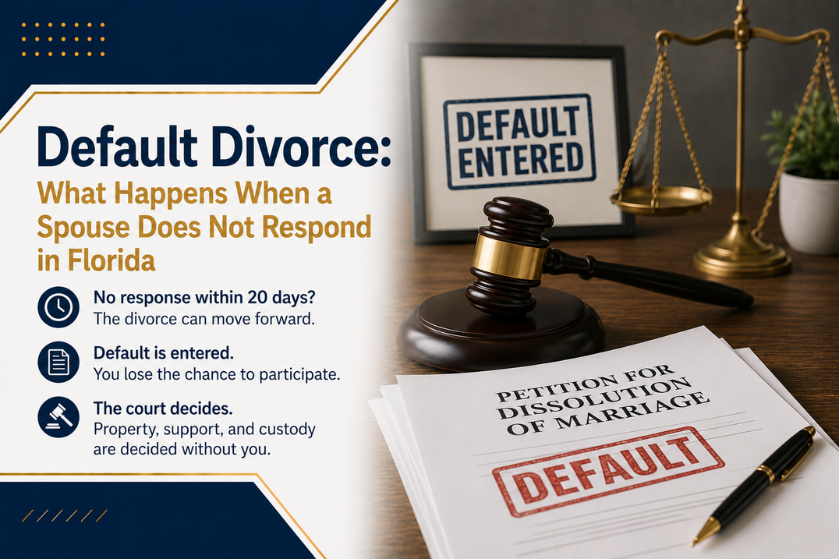
A default divorce in Florida happens when the spouse who was served with divorce papers does not file a written response within 20 days of being served. Once that deadline passes, the filing spouse can ask the court clerk to enter a default, which allows the divorce to move forward without the non-responding spouse’s participation. The judge can then grant the divorce and divide property based entirely on what the filing spouse requests.
Default divorces are more common than many people expect. Some spouses refuse to engage. Others simply disappear. A few do not understand the 20-day deadline or believe ignoring the paperwork makes the divorce go away. It does not. The divorce proceeds with or without a response, and the non-responding spouse loses the chance to shape any part of the outcome.
At Justin Andersson, P.A., we help Panama City, Bay County, and Northwest Florida clients on both sides of default divorce situations. Whether you are the filing spouse trying to move forward or the non-responding spouse trying to undo a default, understanding the process matters.
What Is a Default Divorce in Florida?
A default divorce is a divorce judgment entered when one spouse fails to respond to the petition within the time allowed by Florida law. Under Florida Rule of Family Law Procedure 12.140, the responding spouse has 20 days after being served to file a written response with the circuit court.
If no response is filed within 20 days, the filing spouse can request a Clerk’s Default. The clerk enters the default, which formally closes the window for the other spouse to participate. The case then proceeds to a default final hearing where the judge reviews the petition and enters a judgment.
The default does not mean the marriage ended the moment the 20 days passed. It means the court will now hear only one side of the story when deciding how to divide property, award alimony, and set parenting arrangements.
What Happens After a Default Is Entered?
Once the clerk enters the default, the filing spouse schedules a default final hearing before the judge. At this hearing, only the filing spouse appears. The judge reviews the filed petition, any proposed marital settlement agreement, and the financial affidavit.
The judge cannot simply rubber-stamp whatever the filing spouse asks for. The court still reviews child support calculations to make sure they comply with Florida’s statutory guidelines under Fla. Stat. § 61.30. Parenting plans must still meet the best interest of the child standard under Fla. Stat. § 61.13. Alimony requests must be reasonable given the financial information disclosed.
What the judge will not do is invite the non-responding spouse to participate or wait for them to object. The non-responding spouse had their chance and missed it. The case moves forward on the record as presented.
Can a Non-Responding Spouse Still Be Heard?
Yes, but only through a formal motion to set aside the default. Under Florida Rule of Civil Procedure 1.540, a defaulted spouse can ask the court to undo the default and allow them to participate. The window for this relief is limited and the burden is on the defaulted party.
Common grounds for setting aside a default include excusable neglect, such as a genuine misunderstanding about the deadline or a failure to receive the papers through no fault of the served party. Courts also consider whether the defaulted spouse has a meritorious defense to the petition.
Acting quickly matters more than anything else. A judge is far more likely to set aside a default entered last week than one resulting in a final judgment entered months ago. A default final judgment is much harder to undo and requires fraud, newly discovered evidence, or other grounds under Rule 1.540(b).
What Does the Filing Spouse Need to Prove at a Default Hearing?
The filing spouse still carries the burden of showing the court everything required for a valid Florida divorce. These items must be established at the default hearing even without opposition:
- Florida residency for at least six months before filing
- The marriage is irretrievably broken
- Proper service of process on the responding spouse
- Financial affidavit disclosing all assets, debts, income, and expenses
- A proposed parenting plan if children are involved
- Child support calculations matching statutory guidelines
The judge reviews all of these before signing the final judgment. Errors in the petition, missing financial disclosure, or child support calculations that do not match Florida guidelines can delay the default judgment even without a contesting spouse.
What Can a Default Divorce Include?
A default divorce can address every issue a contested divorce covers. Property division, alimony, child custody, time-sharing, child support, and debt allocation all get resolved in the final default judgment based on what the filing spouse requested.
Property awarded in a default divorce follows equitable distribution principles under Fla. Stat. § 61.075. Courts do not automatically give everything to the filing spouse simply because the other spouse did not respond. The judge still reviews the petition for reasonableness and requires appropriate financial disclosure before signing.
Alimony in a default divorce is set based on what the filing spouse requests and what the financial affidavit supports. Courts do not award alimony that exceeds what the statutory factors would support under Fla. Stat. § 61.08 in a contested case.
Is a Default Divorce Faster Than a Contested Divorce?
Usually yes, though the timeline depends on the court’s docket and how quickly the filing spouse moves after the default is entered. In Bay County, uncomplicated default divorces with no children often close in 45 to 90 days from the date of filing.
Cases involving children, significant assets, or real estate typically take longer even in default. The court must review parenting plans, calculate child support, and address property issues carefully regardless of whether the other spouse responded.
By comparison, contested divorces in Bay County regularly run six to eighteen months depending on the level of dispute, the number of hearings required, and how long discovery takes. Default divorces skip all of that if the non-responding spouse stays silent.
What If the Non-Responding Spouse Cannot Be Found?
When a spouse cannot be located after a diligent search, Florida law allows service by publication under Fla. Stat. § 49.011. The filing spouse publishes a legal notice in a newspaper of general circulation in the county where the respondent last lived, once a week for four consecutive weeks. This is a separate procedure from standard service of process.
Service by publication triggers a 30-day response window rather than the standard 20 days. If no response arrives, the clerk enters a default and the case proceeds. However, a default divorce based on publication service cannot address property division or alimony in many circumstances. Personal service is required for those provisions to be binding.
The divorce itself can still be granted on publication. It legally ends the marriage even when only one spouse appears and the other cannot be found.
Frequently Asked Questions
The divorce moves forward without you. After 20 days, the filing spouse can enter a default and proceed to final judgment without your participation. You lose all input into property division, custody, and alimony.
You can try. Filing a response after the 20-day window requires a motion to set aside the default. Courts consider whether you had a valid reason for the delay and whether you have a legitimate defense.
The filing spouse must attend the default final hearing. The non-responding spouse is not required to attend and typically does not. In some simple cases with no children and no disputed property, the judge may accept written submissions without requiring an in-person hearing.
Yes, though appeals face strict deadlines and limited grounds. A better path in most cases is a motion to set aside the default under Rule 1.540 before the judgment becomes final.
No. Florida courts always retain jurisdiction to modify custody and child support based on substantial changes in circumstances. A default custody order is a starting point, not a permanent arrangement.
Talk to a Florida Family Attorney About Your Default Divorce
Whether you are pursuing a default divorce because your spouse will not respond, or scrambling to undo a default entered against you, the process has strict deadlines and real consequences. Justin Andersson, P.A. helps clients across Panama City and Bay County move through default divorces efficiently and fight to set aside defaults when the other side acted improperly.