
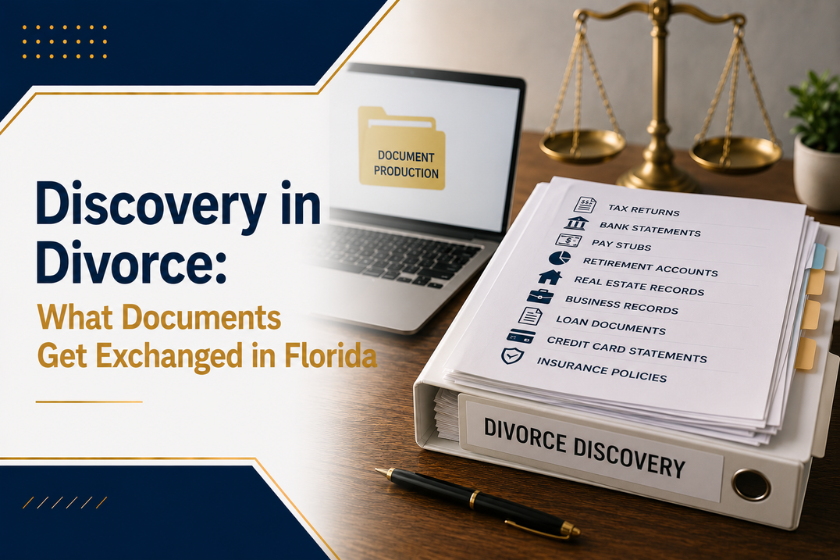
Discovery in a Florida divorce is the formal legal process where both spouses exchange financial records, personal documents, and other evidence before the case goes to trial. Florida Family Law Rule 12.285 requires mandatory disclosure from both parties without anyone having to ask. On top of that, either side can serve additional requests for documents, written questions, and depositions to build the full picture of the marital estate.
Most contested divorces in Bay County run on the documents produced during discovery. Property division, alimony, and child support calculations all depend on financial records that discovery forces into the open. A spouse who controls the household finances cannot simply decide not to share that information. Discovery is how the other side gets access.
At Justin Andersson, P.A., we guide Panama City and Northwest Florida clients through discovery from both sides. Whether you need to gather documents or respond accurately to what the other side is asking for, the discovery phase often determines how much negotiating power each spouse carries into settlement.
What Is Mandatory Disclosure in a Florida Divorce?
Mandatory disclosure under Florida Family Law Rule 12.285 requires both spouses to automatically exchange a specific set of documents within 45 days of service of the initial petition. Neither party needs to formally request these documents. They are required in every contested case unless both spouses agree in writing to waive them.
The standard mandatory disclosure package includes the last three years of tax returns, the last three months of bank statements for every account, pay stubs covering the last three months, loan applications from the past 12 months, deeds and titles for real property and vehicles, and a completed financial affidavit signed under oath.
Financial affidavits are particularly important. Florida requires a short-form affidavit when combined monthly net income falls under $10,000 and a long-form affidavit in higher-income cases. Both list every asset, every debt, all income, and all monthly expenses. Signing a false affidavit is perjury.
What Additional Discovery Can Each Side Request?
Beyond mandatory disclosure, either spouse can serve formal discovery requests targeting specific financial information the standard package does not fully cover. The three main tools are interrogatories, requests for production of documents, and depositions.
Interrogatories are written questions the other spouse must answer in writing under oath within 30 days. Florida limits each party to 30 interrogatories in most family law cases. Common questions cover business ownership details, all financial account information, specifics about property acquired during the marriage, and explanation of any financial transactions in the years before filing.
Requests for production ask the other spouse to produce specific documents. This tool reaches items not covered by mandatory disclosure, such as individual business tax returns, K-1 forms from partnerships, stock option agreements, brokerage records, and communications relevant to contested issues.
Depositions take discovery into a live question-and-answer format under oath. Anything reasonably likely to lead to admissible evidence can be explored in a deposition. Bay County attorneys use depositions strategically after reviewing all written discovery, targeting the gaps and inconsistencies those documents reveal.
What Financial Documents Does Discovery Typically Uncover?
The scope of documents exchanged in a contested Florida divorce can be substantial depending on the complexity of the marital estate. Standard categories include:
- Bank account statements (checking, savings, money market) for three or more years
- Investment and brokerage account statements
- Retirement account statements (401k, IRA, pension)
- Business financial statements (profit and loss, balance sheets, tax returns)
- Real estate records including deeds, mortgages, and appraisals
- Vehicle titles and loan documents
- Life insurance policies with cash value
- Student loan, credit card, and personal loan statements
- Stock option grants, vesting schedules, and deferred compensation documents
- Cryptocurrency account records
The standard three-year lookback period covers most intentional financial maneuvers. Attorneys and forensic accountants reviewing these records look for unexplained withdrawals, transfers to undisclosed accounts, and income that does not match reported tax figures.
How Does Discovery Help With Hidden Assets?
Discovery is the primary legal tool used to uncover hidden assets in Florida divorce. Subpoenas issued directly to banks, brokerage firms, and employers bypass the non-disclosing spouse entirely. The financial institution receives the subpoena and must respond regardless of what the spouse says.
Bank subpoenas frequently reveal accounts the other spouse denied having. Employer subpoenas confirm actual compensation, bonus structures, and stock awards that a spouse underreported. Business partner subpoenas surface revenue arrangements and deferred income that disappear from reported financials at convenient times.
In Bay County cases involving self-employed spouses or business owners, forensic accountants compare lifestyle spending against reported income. When a family spent $200,000 in a year but reported $85,000 in income, the gap requires an explanation. Discovery provides the raw material that forensic accountants use in business valuation disputes and hidden asset cases alike.
What Happens If a Spouse Fails to Comply With Discovery?
Failure to produce required documents or answer interrogatories on time has real consequences in Florida courts. The complying spouse can file a Motion to Compel, which asks the judge to order the non-compliant spouse to produce the outstanding material.
If the court grants the motion to compel and the other spouse still refuses, sanctions follow. Florida courts can award attorney fees caused by the non-compliance, strike pleadings that depend on the withheld information, or in severe cases, enter a default against the non-complying party.
Deliberate destruction or hiding of documents subject to a discovery request can result in spoliation sanctions. Courts have ordered judges to instruct fact-finders that missing evidence supports an unfavorable inference — in bench trials, the judge makes that inference directly against the non-complying spouse.
How Long Does Discovery Take in a Florida Divorce?
Discovery timelines vary depending on case complexity and cooperation. Straightforward cases between two W-2 employees with a home and retirement accounts may complete discovery in 60 to 90 days.
Cases involving self-employed spouses, multiple businesses, or significant investment portfolios typically run four to nine months in discovery alone. Business valuation reports, forensic accountant analyses, and expert depositions all add time to the process.
Bay County courts have specific discovery cutoff deadlines tied to trial schedules. Missing those deadlines can result in being barred from using evidence that was not timely produced. Treating discovery as an afterthought rather than an immediate priority regularly damages cases that started with strong facts.
What Is a Protective Order and When Is It Used in Discovery?
A protective order limits or restricts what one party must disclose in discovery. Courts grant them when the information requested is privileged, confidential, or where the request is calculated to harass rather than gather legitimate evidence.
Common scenarios for protective orders in Florida divorce include shielding legitimately trade-secret business information from a spouse who competed in the same industry, protecting children’s therapy records where disclosure would harm the child’s wellbeing, and limiting social media fishing expeditions to relevant time periods.
Protective orders do not block legitimate financial discovery. A spouse who requests a protective order to avoid producing financial records will not succeed. Courts recognize the difference between protecting genuine confidentiality interests and using procedure to hide marital assets.
Frequently Asked Questions
Mandatory disclosure is required in every contested case unless both spouses waive it in writing. Additional discovery tools are used based on the complexity of the financial issues involved.
Yes. Subpoenas to cryptocurrency exchanges and forensic blockchain analysis can identify holdings even when a spouse claims they have none. Courts have ordered disclosure of crypto wallet addresses and private keys.
The standard lookback is three years for most financial documents. Courts can authorize longer lookback periods when evidence suggests financial manipulation predating that window.
Your attorney can file a motion to compel, request supplemental production, or subpoena the documents directly from the financial institution. Incomplete production often reveals more about what is being hidden than complete production does.
Yes. Documents produced in discovery frequently drive settlement. A spouse who knows the other side has their complete financial picture is less likely to hold out for unrealistic demands.
Talk to a Florida Family Attorney About the Discovery Process
Discovery is where Florida divorces are won or lost before anyone sets foot in a courtroom. The documents produced, the interrogatories answered, and the depositions taken build the entire factual record that drives settlement or trial. Justin Andersson, P.A. handles discovery aggressively for clients across Panama City and Bay County so that the financial picture the court sees is complete and accurate.