
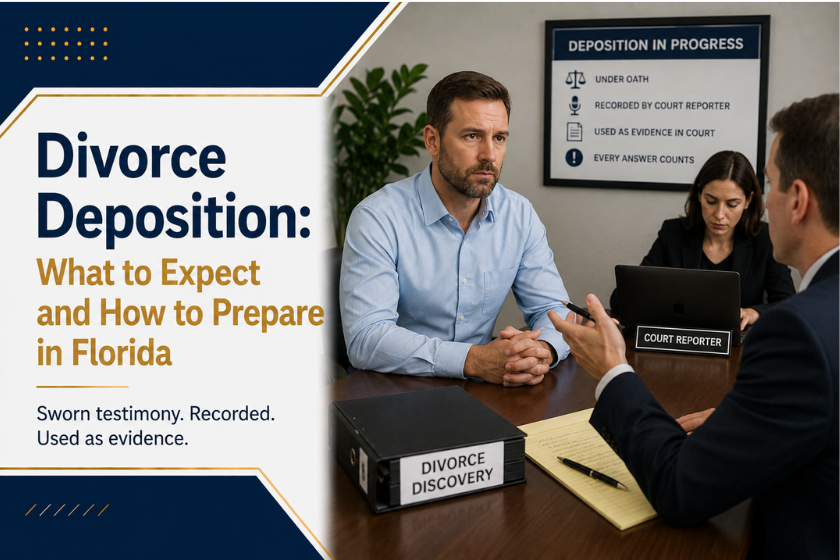
A deposition in a divorce case is sworn testimony given outside the courtroom, recorded by a court reporter, and used as evidence during settlement negotiations or trial. In Florida, depositions in family law cases are governed by Fla. R. Civ. P. 1.310. The opposing attorney asks you questions under oath, your attorney can object, and everything you say becomes part of the official court record.
Most people going through divorce in Bay County have never sat in a deposition before. That unfamiliarity is exactly what the opposing attorney hopes to use. Walking in prepared makes the difference between testimony that helps your case and testimony that hurts it months later at trial.
At Justin Andersson, P.A., we prepare Panama City and Northwest Florida clients for depositions in every contested divorce case where opposing counsel requests one. Preparation is not optional when something you say under oath can follow you all the way to the final hearing.
What Is a Divorce Deposition in Florida?
A deposition is a formal question-and-answer session conducted under oath before a licensed court reporter. The court reporter transcribes every word spoken in the room. The transcript becomes a legal document that both sides can use at trial, in motions, and during settlement talks.
In Florida, either spouse can be deposed. Third parties can also be deposed, including business partners, accountants, family members with knowledge of finances or parenting, and any expert witnesses either side retains. A deposition can happen before trial, before hearings, or as part of discovery.
Unlike a courtroom, depositions happen in a conference room, typically at one attorney’s office. There is no judge present. The court reporter administers the oath and records the testimony. The rules about what can be asked are broader than at trial, because discovery allows questions about anything reasonably likely to lead to admissible evidence.
When Are Depositions Used in Florida Divorce Cases?
Depositions are most common in contested divorces involving significant financial disputes, custody battles, or claims of misconduct. If the divorce is uncontested and both spouses agree on everything, depositions are rarely needed or requested.
In cases involving hidden assets, business valuation disputes, or custody disputes with competing expert testimony, depositions serve specific strategic purposes. The deposing attorney uses the session to lock the other spouse into their story, probe financial details not fully disclosed in written discovery, and gather material to attack credibility at trial.
Florida’s discovery rules under Fla. R. Civ. P. 1.280 permit depositions as part of the broader discovery process. Depositions in Bay County divorce cases typically happen after written discovery (interrogatories and document requests) is complete, because the deposing attorney then knows what documents exist and can ask pointed questions about them.
Who Can Be Deposed in a Divorce Case?
Either spouse, any third-party witnesses, and any expert retained by either party can be deposed. Common deposition targets in Bay County divorce cases include:
- The other spouse (most common)
- The other spouse’s business partner or accountant
- A forensic accountant retained by either side
- A child custody evaluator or guardian ad litem
- A real estate appraiser valuing the marital home
- Family members who witnessed financial conduct or parenting
- Employers or HR representatives for income verification
Third-party witnesses receive a deposition subpoena rather than a notice of deposition. They must appear unless a court excuses them. Expert witnesses are almost always deposed before trial in complex cases to preview their testimony and identify weaknesses in their methodology.
What Questions Get Asked at a Divorce Deposition?
Opposing counsel can ask almost anything at a deposition that might reasonably lead to admissible evidence. Common topics in Florida divorce depositions include:
- Full financial history: income, assets, debts, accounts, and spending
- Business ownership, revenue, and compensation arrangements
- Employment history and earning capacity
- The nature and value of property acquired during the marriage
- Pre-marital assets and when they were acquired
- Parenting involvement, daily routines, and childcare arrangements
- Any communications between the spouses during separation
The opposing attorney asks follow-up questions when an answer seems incomplete or evasive. Fishing for inconsistencies between your deposition testimony and earlier written interrogatory answers is a primary goal.
How Should You Prepare for Your Divorce Deposition?
Preparation starts well before the deposition date. Your attorney reviews every document you have already produced, every interrogatory answer you have submitted, and every financial affidavit filed with the court. Contradicting your own prior statements under oath damages credibility badly.
The most important rule is to answer only what is asked. Do not volunteer information the question did not seek. If the question asks when you bought the house, answer with the date. Do not also explain why, what happened after, or what you think the house is worth now unless asked. Every extra word is a gift to the opposing attorney.
Pause before answering every question, even when you know the answer immediately. This gives your attorney time to object, gives you time to think, and prevents the rushed answers that lead to regrettable testimony. Asking for clarification when a question is confusing is always better than guessing at what was meant.
What Can Your Attorney Do During a Deposition?
Your attorney cannot answer questions for you, but they play an active role throughout the session. Attorneys object to improper questions on the record, direct you to take breaks, clarify confusing exchanges, and follow up with their own questions when the opposing attorney finishes.
Valid objections in Florida depositions include objections to form, hearsay, privilege, and relevance. Objecting does not stop you from answering in most cases. It preserves the issue for the judge to rule on later. Your attorney says “objection, form” and you typically answer anyway unless your attorney instructs you not to.
Attorneys can instruct you not to answer only for privileged attorney-client communications, physically harmful questions, or court-ordered protective topics. Outside those narrow exceptions, refusing to answer risks sanctions.
What Happens to Your Deposition Testimony?
The court reporter produces a written transcript within a few days to several weeks. You have 30 days after receipt to review it and note errors in a written errata sheet. Courts look skeptically at major revisions that go beyond typos.
Opposing counsel uses the transcript in several ways. Inconsistencies between deposition answers and trial testimony attack credibility directly in front of the judge. Admissions made during the deposition can be introduced as evidence. This is especially significant in cases involving property division disputes or child custody where credibility determines outcomes.
Settlement negotiations often shift after depositions reveal new information or lock a spouse into a weaker position. A poorly handled deposition can force a confident spouse to reconsider their demands entirely.
Frequently Asked Questions
Generally no. Refusing to answer without a valid legal basis can result in a court order compelling your testimony and sanctions against your case.
Most Bay County divorce depositions run two to four hours. Cases involving business interests, custody disputes, or substantial assets can run a full day.
Settlement agreements reached after depositions typically include confidentiality provisions that limit how deposition testimony is used. But the transcript remains part of the court record.
Judges typically see deposition transcripts only when they are submitted as exhibits or when inconsistencies are highlighted by counsel during trial. They do not read depositions in advance.
Video depositions capture tone, body language, and facial expressions in addition to the words. They are more powerful at trial because the judge sees and hears the testimony directly rather than reading it.
Talk to a Florida Family Attorney Before Your Divorce Deposition
Walking into a deposition unprepared is one of the most costly mistakes in a contested divorce. What you say under oath follows you all the way through the case. Justin Andersson, P.A. prepares clients across Panama City and Bay County for depositions in contested divorce, custody, and asset division cases so that testimony strengthens the case rather than sinking it.