
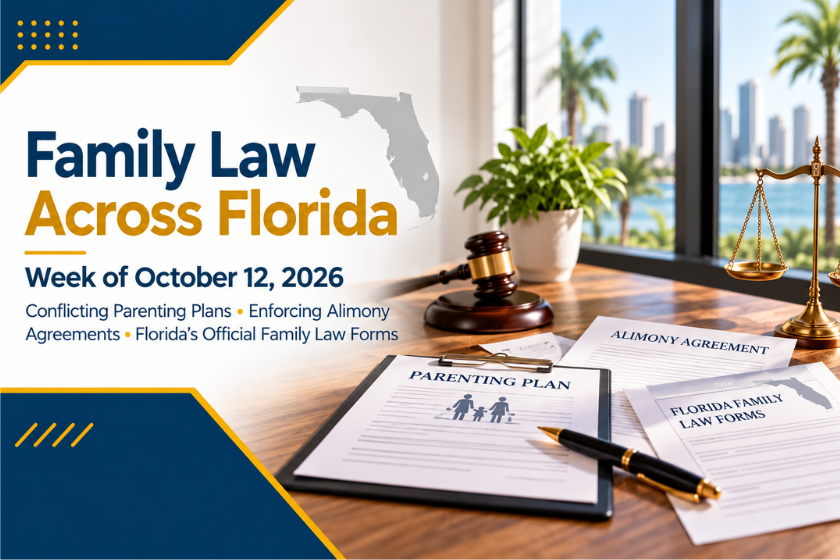
Every week, Florida’s appeals courts and the Florida Supreme Court decide issues that shape how divorces, parenting plans, and support work for families across the state. Here are three developments from the past few weeks worth knowing about if you live in the Panhandle and are going through a family law matter.
1. When your judgment and parenting plan do not match
On October 9, Florida’s Fifth District Court of Appeal decided Janosky v. Janosky. The final judgment gave each parent certain weekdays, but the parenting plan attached to it arguably gave those same days to the other parent. The judgment also required the parents to communicate only through a co-parenting app, while the plan allowed calls, texts, and email. The appeals court found the judgment ambiguous and inconsistent and sent those parts back to be fixed. It also reversed a home buyout provision that did not address the other spouse’s mortgage liability.
Bay County is in the First District. Trial judges here generally follow decisions from other districts unless the First District has decided an issue differently, and in this case the court cited a First District decision that reached a similar result. The lesson travels well: read your judgment and parenting plan side by side before anything is signed, and make sure the house terms say what happens to the mortgage.
Read the decision: Janosky v. Janosky, No. 5D2025-1404 (Fla. 5th DCA Oct. 9, 2026)
2. A signed settlement can be enforced like a court order
On October 7, the Fourth District decided Kennedy v. Kennedy. A former husband argued that federal law limited garnishment of his benefits to 25 percent because his alimony came from a settlement agreement rather than a judge’s ruling. The court disagreed. Because the divorce judgment incorporated the agreement, ordered both parties to follow it, and kept jurisdiction to enforce it, the court treated the alimony terms as a court support order, which allowed a higher withholding rate for past due alimony.
Bay County trial judges generally follow decisions like this one unless the First District has ruled differently. Either way, it is a good reminder that a marital settlement agreement is not a handshake. Once a judge approves it, its support terms can be enforced with the same tools as any other court order, so it deserves careful review before you sign.
Read the decision: Kennedy v. Kennedy, Nos. 4D2025-2845 and 4D2026-1196 (Fla. 4th DCA Oct. 7, 2026)
3. Florida's family law forms now have one home
Effective October 1, the Florida Supreme Court designated all state family law forms as Florida Supreme Court Approved Family Law Forms and consolidated responsibility for keeping them current. Forms you already have remain valid, though their titles will change over time, and the forms will be maintained on the Family Courts page of the Florida Courts website. The court is accepting comments on the change through November 24, 2026. This change applies statewide, including here in Bay County.
If you are handling part of your case on your own, start with the official forms from the Florida Courts website rather than an old copy or a third party site.
Read more: The Florida Bar News, “Supreme Court unifies Florida family law forms”
The takeaway
All three items point to the same idea: the details in your paperwork matter. Clear parenting schedules, carefully reviewed settlement terms, and current forms can save time, money, and stress later. If you have questions about a divorce, parenting plan, support, or paternity issue in the Panhandle, we are glad to talk. Call (850) 871-7397 or visit our website to schedule a consultation.
Both appellate decisions discussed above are not yet final. This post is general information about Florida law, not legal advice. Reading it does not create an attorney client relationship.