
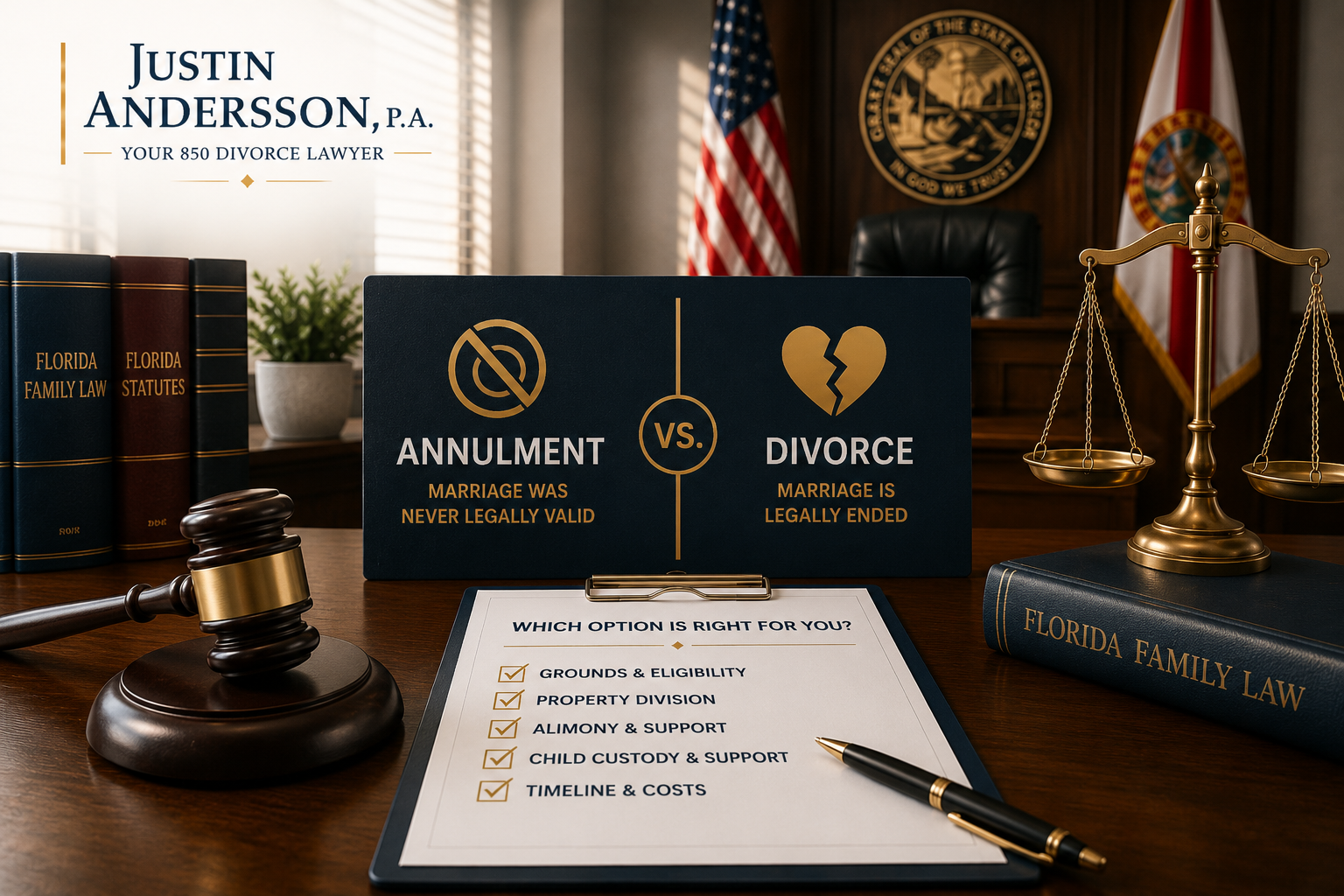
Annulment declares that a marriage was never legally valid, while divorce ends a legally valid marriage. In Florida, annulments are reserved for narrow situations like fraud, bigamy, or coercion. Divorce is available to any legally married couple who wants to end the relationship.
Most people who think they qualify for annulment actually need a divorce. Florida grants annulments in only a handful of specific circumstances, and courts hold applicants to a high burden of proof. Understanding which option fits your situation saves time, money, and unnecessary courtroom disappointment.
At Justin Andersson, P.A., we help couples across Panama City, Bay County, and the greater Northwest Florida panhandle sort out which legal path applies to their marriage. A short conversation usually settles the question quickly.
What Is the Difference Between Annulment and Divorce in Florida?
A divorce, called dissolution of marriage in Florida, ends a valid marriage. Both spouses agree the marriage was real, but one or both want it to end. Courts divide property, may award alimony, and enter parenting orders if children are involved.
An annulment declares that no valid marriage ever existed. The court treats the spouses as if they were never married in the eyes of the law. This distinction changes everything about property, support, and paperwork afterward.
Florida makes divorce the default option. State law provides clear procedures under Chapter 61 for dissolving a valid marriage. Annulment comes from older Florida case law rather than a specific statute, which is why courts scrutinize these cases carefully.
What Are the Grounds for Annulment in Florida?
Annulment is only available when specific legal defects existed at the time of the wedding. The most common grounds include:
- Bigamy, meaning one spouse was already married to someone else
- Fraud that goes to the essence of marriage, such as concealed inability to have children when both wanted a family
- One or both spouses were underage without proper parental consent
- Mental incapacity at the time of the wedding
- One spouse was intoxicated to the point of not understanding what they were doing
- Coercion or duress that forced one party into the marriage
- Incest between close blood relatives prohibited by Florida law
Simply being unhappy, changing your mind, or discovering marital problems does not qualify. Fraud claims must involve serious deception about something fundamental to the marriage, not disappointment about smaller matters that came up later.
Courts look for deception the innocent spouse could not have discovered before the wedding through reasonable inquiry.
What Is the Difference Between Void and Voidable Marriages?
Florida law separates annulment cases into two categories. Understanding which applies to your situation matters because the rules differ.
A void marriage was never legally valid from day one. Bigamy and incest fall here. These marriages are legally treated as if they never happened, and any party or the state can challenge them at any time.
A voidable marriage looks valid on paper but has a legal defect one spouse can challenge. Fraud, duress, underage marriage, and mental incapacity fall here. Voidable marriages remain valid until a court declares them annulled, and time limits often apply to file.
When Should You Choose Divorce Instead of Annulment?
Divorce is the right option for most couples ending a marriage. If both spouses were adults, understood what they were doing, and the marriage was legally valid at the time, annulment is not available no matter how the relationship soured later on.
Long marriages almost always require divorce. Annulment based on fraud generally requires prompt action once the fraud is discovered. Waiting years and then trying to annul the marriage rarely succeeds in Florida courts.
Divorce also protects rights annulment does not. A divorcing spouse can seek alimony, request equitable distribution of marital property, and rely on Florida statutes with predictable outcomes. Annulment lacks these protections in most cases.
How Does Annulment Affect Property, Alimony, and Children?
Because annulment declares the marriage never existed, alimony is generally not available. The theory is straightforward: without a valid marriage, one party owes no spousal support obligation to the other.
Property division works differently in annulment cases. Florida courts often use equitable powers to divide property fairly, especially when the annulment stems from voidable rather than void grounds. Assets acquired together may still be split reasonably between the parties.
Real estate purchased jointly, joint bank accounts, and shared retirement contributions often become the trickiest issues. Courts look at who paid for what, whose name is on titles, and what each party contributed during the time the couple lived together. Judges have wider discretion in annulment cases than in standard divorces, which can help or hurt depending on the facts.
Children born during an annulled marriage remain legitimate under Florida law. Both parents retain rights and responsibilities toward the children. The court still enters parenting plans, timesharing schedules, and child support orders using the same standards as any divorce case.
How Do You File for Annulment in Florida?
Annulment starts with filing a Petition for Annulment in the circuit court where either spouse lives. Unlike divorce, Florida does not require a six-month residency period before filing this petition.
The petitioning spouse must plead the specific grounds and provide evidence. Fraud, duress, and mental incapacity claims often require witness testimony, medical records, or other documentation. Courts do not take annulment claims lightly at any level.
Once the petition is filed, the other spouse must be served with legal notice. They then have 20 days to respond. Uncontested annulments where the other party agrees can move faster than contested cases.
If contested, the case may involve a full hearing where the petitioner must prove the grounds by clear and convincing evidence. This higher standard makes annulment harder to win than divorce, which uses a lower burden of proof under Florida law.
Which Option Costs Less and Takes Less Time?
Uncontested divorce typically costs less and moves faster than annulment. A straightforward Florida divorce can close in 30 to 90 days when both spouses agree. Annulment often takes longer because grounds must be proven with strong evidence.
Contested annulments can drag on for months. Fraud cases especially require depositions, witness testimony, and detailed evidence gathering. Court time adds up quickly, and legal fees follow the same pattern.
Choosing divorce over annulment usually saves both time and money, even when annulment technically applies. Only cases where the legal validity of the marriage genuinely matters justify the extra effort involved.
Frequently Asked Questions
No residency requirement applies to annulment. Divorce requires six months of Florida residency, but annulment can be filed as soon as you and the marriage meet the legal criteria.
No. Infidelity is grounds for divorce under no-fault rules but not for annulment. Annulment requires legal defects at the time of the wedding, not events that happened afterward.
Time limits depend on the grounds. Voidable marriage claims like fraud often require prompt filing once the defect is discovered. Void marriages such as bigamy can be challenged at any time.
Yes. Florida law protects children's legitimacy regardless of whether the parents' marriage is later annulled. Custody and support proceed as with any divorce.
No. A religious annulment from a church or faith community has no legal effect. Only a Florida court can grant a legal annulment that changes your civil marital status.
Annulment cases involve tougher proof standards than divorce. Working with an experienced Florida family attorney gives you the best chance of a successful outcome in court.
Talk to a Florida Family Attorney Before You Decide
The choice between annulment and divorce affects property, support, and how the record of your marriage looks legally. Getting the wrong direction costs both time and money. Justin Andersson, P.A. helps clients across Panama City and Bay County determine which path fits their situation and files the paperwork correctly the first time.