
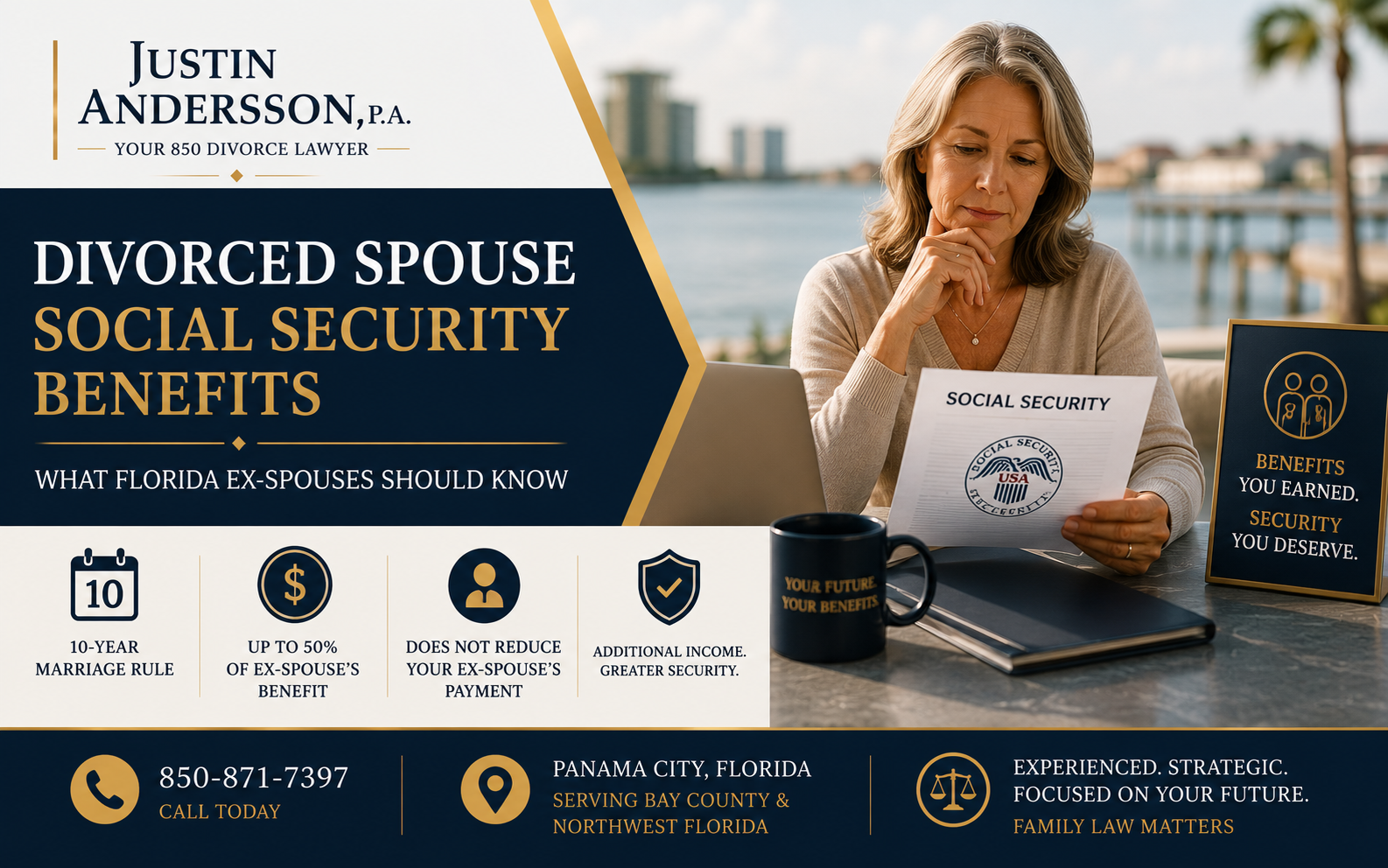
A divorced spouse may collect Social Security benefits based on a former spouse’s earnings record if the marriage lasted at least 10 years and the ex-spouse claiming the benefit is at least 62 years old. This federal benefit is separate from Florida alimony and does not reduce the working spouse’s Social Security payments in any way. Understanding how these benefits work can add hundreds of dollars to your monthly income after divorce.
Many Florida ex-spouses never realize they qualify for these benefits. The Social Security Administration does not send reminders, and divorce lawyers do not always mention them during the divorce itself. Learning the rules protects income that legally belongs to you under federal law.
At Justin Andersson, P.A., we help clients across Panama City, Bay County, and the Northwest Florida panhandle understand how their divorce affects Social Security, retirement accounts, and long-term financial security. A short conversation can identify money you may be leaving on the table.
Who Qualifies for Divorced Spouse Social Security Benefits?
The Social Security Administration sets specific rules for divorced spouse benefits. You may qualify if all of the following are true:
- Your marriage lasted at least 10 years
- You are at least 62 years old when you file
- You are currently unmarried
- Your ex-spouse is entitled to Social Security retirement or disability benefits
- Your own Social Security benefit (based on your work record) would be smaller than half of your ex-spouse’s benefit
If your ex-spouse has not yet applied for Social Security but qualifies to receive it, you can still claim divorced spouse benefits as long as you have been divorced for at least two years. This two-year rule protects ex-spouses from being held hostage to a working spouse’s decision to delay filing.
Understanding these rules matters because many divorced Florida residents miss out on income they earned during their marriage.
How Much Can You Receive From an Ex-Spouse's Record?
The maximum divorced spouse benefit equals 50% of your ex-spouse’s Primary Insurance Amount (PIA) at their Full Retirement Age. Full Retirement Age is 66 to 67, depending on birth year. If your ex-spouse’s PIA is $2,400 per month, the maximum divorced spouse benefit is $1,200 per month.
Claiming before your own Full Retirement Age reduces the benefit. Filing at 62 typically drops the payment to about 32.5% of the ex-spouse’s PIA rather than the full 50%. Waiting until your Full Retirement Age unlocks the full amount.
Delayed retirement credits do not apply to divorced spouse benefits. Waiting past your Full Retirement Age does not increase the payment further, so filing at Full Retirement Age is usually the smart choice unless other factors apply.
Does Claiming Ex-Spouse Benefits Reduce Your Ex-Spouse's Payment?
No. This is one of the most misunderstood parts of the rule. Your claim for divorced spouse benefits has zero effect on your ex-spouse’s Social Security payment. The Social Security Administration pays you separately from a different pool.
Your ex-spouse also does not need to consent to your claim, does not need to be notified, and cannot block your application. If you meet the eligibility rules, you can file directly with the SSA without any input from your former spouse.
This same rule protects any current spouse your ex has remarried. Your divorced spouse claim does not reduce what their current spouse might receive either. Federal law treats all these benefits independently.
What Is the 10-Year Marriage Rule for Social Security?
The 10-year rule is the single most important requirement for divorced spouse benefits. Your marriage must have lasted at least 10 years from the date of marriage to the date the divorce judgment is final.
Coming up short by even a few days can disqualify you. Some couples in late-year divorce proceedings intentionally delay the final judgment to cross the 10-year mark for exactly this reason. Talking to an attorney before finalizing the divorce protects your future benefit eligibility.
The 10-year clock cannot be combined across multiple marriages. If you were married to the same person twice for six years and then five years, the SSA looks at each marriage separately. Neither meets the 10-year test on its own, so no benefit applies.
Can You Collect Both Your Own and Ex-Spouse Social Security Benefits?
You cannot collect both at the same time. The Social Security Administration pays you the higher of the two amounts, not both combined. If your own retirement benefit is $1,400 per month and the divorced spouse benefit would be $1,200 per month, you receive the $1,400 payment because it is larger.
The SSA handles the comparison automatically when you apply. You do not have to choose in advance. Filing simply triggers the calculation.
Some people born before January 2, 1954 may still qualify for restricted application benefits, which let them collect an ex-spouse benefit while their own benefit grows through delayed retirement credits. Recent law changes eliminated this option for younger workers. Confirming your specific situation with an experienced attorney or SSA representative matters.
What Happens to Ex-Spouse Benefits If You Remarry?
Remarrying generally ends your right to collect divorced spouse benefits from your first ex-spouse. The moment you remarry, the SSA stops paying divorced spouse benefits on the former spouse’s record.
There are exceptions. If your remarriage ends through divorce, annulment, or death, you can once again claim divorced spouse benefits on your first ex-spouse’s record. The eligibility rules reset once the second marriage is legally over.
Widows and widowers over age 60 face different rules for survivor benefits. Remarriage after age 60 does not affect eligibility to collect survivor benefits from a deceased ex-spouse. This survivor rule saves many older divorced widows from losing income they need.
How Do Divorced Spouse Survivor Benefits Work?
If your ex-spouse dies, you may qualify for divorced spouse survivor benefits instead of divorced spouse benefits. Survivor benefits pay up to 100% of the deceased ex-spouse’s benefit at Full Retirement Age. This is a substantial increase over the 50% cap on standard divorced spouse benefits, which matters especially in gray divorce situations.
Eligibility rules for survivor benefits mirror the standard rules with a few adjustments. The marriage must have lasted at least 10 years, you must be at least 60 (or 50 if disabled), and you must not have remarried before age 60.
Divorced spouse survivor benefits often provide the largest monthly Social Security payment available to older divorced Floridians. Filing timing and coordination with your own retirement benefit can create thousands of dollars in additional lifetime income when done correctly.
Frequently Asked Questions
Providing it makes the application faster, but it is not required. The SSA can locate the record using your ex-spouse's date of birth, place of birth, and parents' names if the number is unavailable.
The SSA does not need current contact information for your ex-spouse. They only need enough information to identify the record. Your ex-spouse is not contacted about your application.
Yes, if you have been divorced at least two years and your ex-spouse is at least 62 years old and qualifies for retirement benefits. The two-year rule protects you from having to wait indefinitely.
No. Social Security is a federal program governed by federal law. Florida divorce laws do not change your eligibility, though the timing of your divorce judgment can affect the 10-year rule.
No. Neither your ex-spouse nor their current spouse has any legal ability to block, reduce, or prevent your divorced spouse benefit claim.
Talk to a Florida Divorce Attorney About Your Long-Term Financial Picture
Divorced spouse Social Security benefits protect income you helped earn during your marriage. Understanding the 10-year rule, remarriage effects, and survivor benefit options makes the difference between claiming what you are owed and leaving thousands on the table. Justin Andersson, P.A. helps clients across Panama City and Bay County plan divorce timing, alimony structure, and retirement decisions with long-term financial security in mind.