
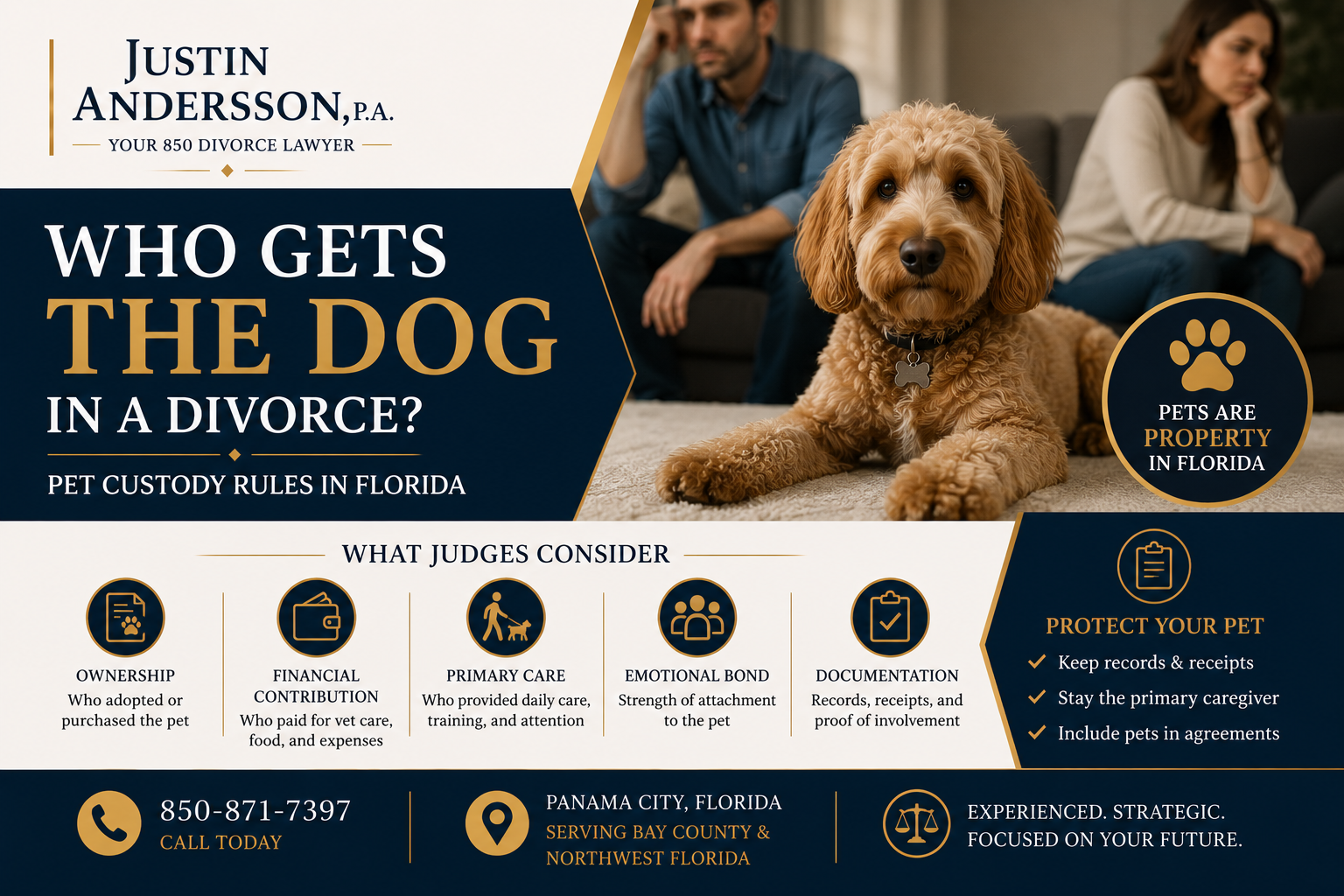
Florida law treats pets as personal property in a divorce, not as family members. There is no “pet custody” or shared visitation schedule for dogs, cats, or other pets in Florida courts. Judges award pets to one spouse based on ownership, financial contribution, and care history, not on what is best for the animal.
This surprises many pet owners going through divorce. Your dog may feel like family, but Florida law puts pets in the same category as cars, furniture, and other marital property. Understanding how judges actually decide these cases helps you build the strongest case for keeping the pet you love.
At Justin Andersson, P.A., we help Panama City, Bay County, and Northwest Florida pet owners protect their four-legged family members during divorce. Building the right paper trail before filing can make the difference between keeping your dog and losing them.
Does Florida Recognize Pet Custody in Divorce?
No. Florida is one of the majority of states that treat pets as personal property in divorce proceedings. Family law judges will not enter “pet custody” orders, visitation schedules, or shared care arrangements for animals.
The landmark case of Bennett v. Bennett confirmed this rule in Florida. The court held that dogs and other pets fall under Chapter 61 property division rules rather than any child-related statutes. This means the pet goes to one spouse permanently after the divorce.
Some newer states like California, Illinois, and Alaska have passed laws requiring courts to consider the best interest of the animal in divorce cases. Florida has not adopted this approach. Efforts to change the law come up in the Florida legislature from time to time but have not passed.
How Do Florida Judges Decide Who Keeps the Pet?
Since pets are property, judges look at ownership factors similar to how they handle cars or furniture. Common factors include:
- Who purchased or adopted the pet originally
- Whose name appears on adoption papers, registration, or microchip records
- Who paid for veterinary care, food, grooming, and other expenses
- Who served as the primary caregiver (feeding, walking, training, vet visits)
- Whether one spouse had strong emotional bonds with the pet before marriage
- Whether children in the household are primarily attached to the pet
Documentation matters enormously. A spouse who can show adoption papers in their name, vet records showing they scheduled every appointment, and receipts for pet expenses over the years has a much stronger claim than a spouse relying on personal statements alone.
Photos, social media posts showing time with the pet, and testimony from friends or family can all support a pet ownership claim during litigation.
What Is the Difference Between Marital and Non-Marital Pets?
Florida law distinguishes between marital property (acquired during marriage) and non-marital property (acquired before marriage, or received as a gift or inheritance) under equitable distribution rules. This distinction matters greatly for pets.
A pet you owned before the marriage is your non-marital property. That pet stays with you in divorce with almost no dispute, regardless of who cared for the animal during the marriage. Adoption records from before the wedding date are strong evidence here.
A pet adopted or purchased jointly during the marriage is marital property. This pet becomes subject to equitable distribution under Fla. Stat. § 61.075. The court decides ownership based on the factors listed above.
Pets given as gifts to one spouse specifically may qualify as non-marital property even if received during the marriage. Wedding present pets or birthday gifts to one spouse can fall into this category with proper evidence.
Can Spouses Agree on a Pet Custody Arrangement?
Yes, and this is often the smartest path. Florida courts will not order shared pet arrangements, but nothing stops divorcing spouses from agreeing to one privately in their marital settlement agreement.
A written agreement can include shared time with the pet, alternating weekends, holiday schedules, and split expenses for veterinary care. Some couples treat the arrangement almost like a parenting plan for the pet.
The key is putting the agreement in writing and having it approved as part of the divorce judgment. Verbal understandings collapse quickly when one spouse decides they no longer want to cooperate. A written arrangement gives both parties clear expectations and enforceable terms.
What About Emotional Support Animals and Service Dogs?
Service dogs and emotional support animals occupy different territory. Service dogs trained under the Americans with Disabilities Act to assist a person with a disability generally stay with the person they serve. Ownership questions rarely arise because the working relationship is clear.
Emotional support animals fall between service dogs and pets. If one spouse relies on the animal for documented mental health support with a doctor’s letter, courts sometimes consider that relationship when awarding the pet. This is not a guaranteed outcome, but it is a factor.
Regular pets adopted for emotional comfort do not receive this special treatment. Only animals with formal documentation as service or support animals get the additional consideration during divorce.
How Do Other States Handle Pet Custody Differently?
Several states have moved toward treating pets more like family members in divorce. California, Illinois, Alaska, New Hampshire, and Maine have laws requiring courts to consider the animal’s well-being when deciding ownership.
These states allow judges to consider factors like which spouse can better care for the pet, which home offers a better environment, and even shared custody arrangements. Some states let judges order joint pet custody similar to child custody arrangements.
Florida has not joined this trend. Even if you moved to Florida from a state with pet-friendly divorce laws, your Florida divorce will follow Florida rules. The property classification applies regardless of where you or the pet lived before.
How Can You Protect Your Pet Before Divorce Happens?
Planning ahead protects your ability to keep your pet if the marriage ends. Steps that build a strong ownership case include:
- Keep adoption papers, registration, and microchip records in your name
- Save receipts for veterinary care, food, and pet supplies you paid for
- Take photos and videos showing your daily involvement with the pet
- Handle vet appointments yourself and keep appointment records
- Address pets specifically in any prenuptial or postnuptial agreement
Prenups and postnups can spell out what happens to specific pets if the marriage ends. Named animals and clear ownership terms in these agreements are enforceable and avoid disputes during divorce.
If separation is likely, having the pet primarily under your care during that time strengthens your case. Judges notice which spouse continued acting as the primary caregiver when the marriage was falling apart. Bay County courts consistently favor the spouse who kept up the daily routines of feeding, walking, and vet visits during that transition.
Frequently Asked Questions
No. Florida courts do not enter shared custody orders for pets. Spouses can agree to a shared arrangement privately, but a judge will not order one over a spouse's objection.
Somewhat. Judges consider caregiving history and emotional attachment, but these factors are weighed alongside financial contribution and paper ownership. Bonds alone rarely win the case.
Nothing forces compliance unless a written agreement was included in the divorce judgment. Verbal promises made during divorce are usually not enforceable afterward.
Yes. A prenuptial or postnuptial agreement can name specific pets and spell out ownership if the marriage ends. Written agreements about pets are enforceable in Florida courts.
The judge decides based on ownership evidence, financial contribution, and caregiving history. Whichever spouse presents the stronger paper trail usually wins.
Talk to a Florida Family Attorney About Protecting Your Pet
Losing a beloved pet in divorce is one of the most heartbreaking outcomes many couples face. Florida’s property classification of pets makes preparation crucial. Justin Andersson, P.A. helps clients across Panama City and Bay County build the paper trail, draft protective agreements, and negotiate settlements that keep pets where they belong.