
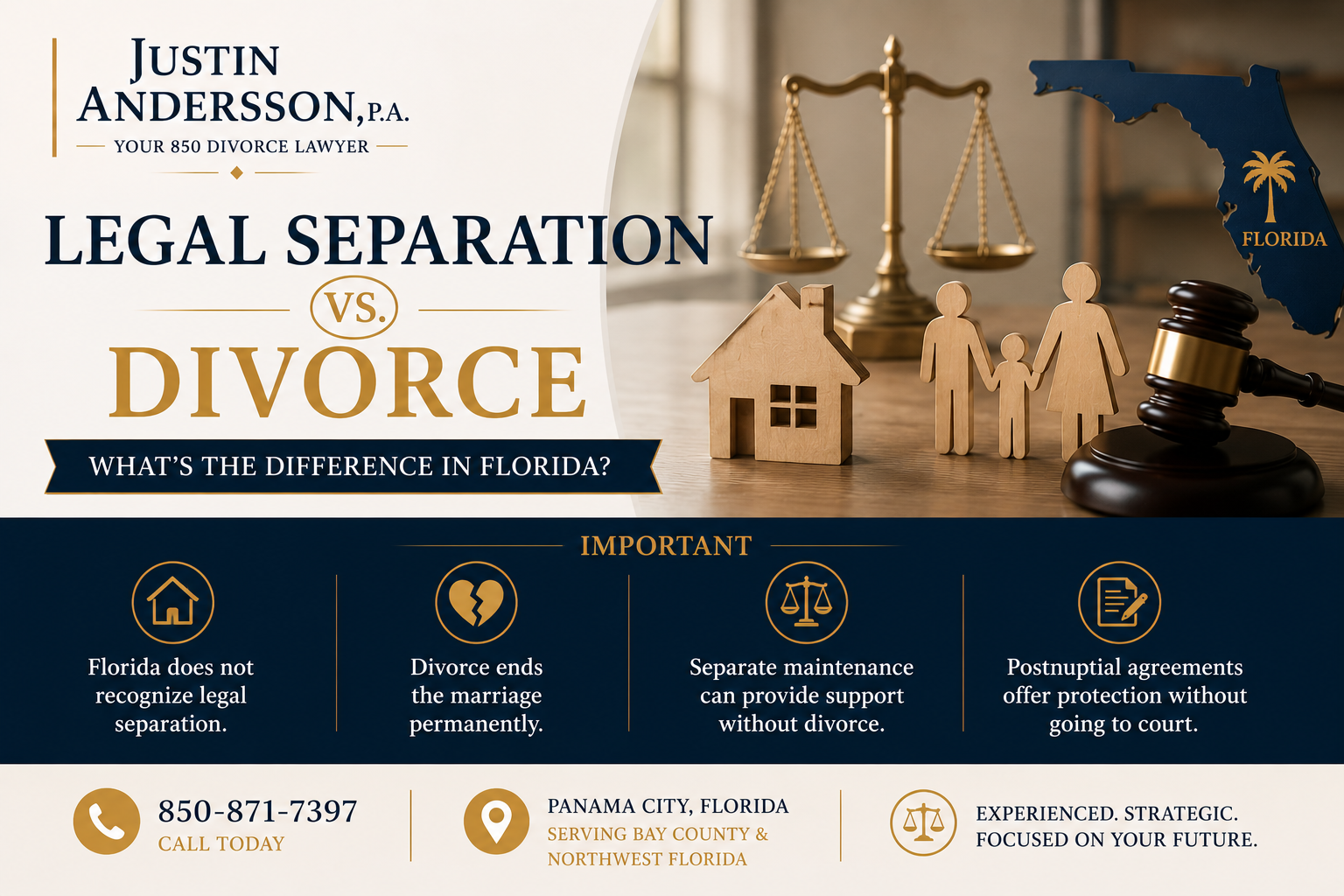
Florida does not recognize legal separation as a formal legal status. Divorce ends the marriage entirely, while legal separation (in states that recognize it) lets spouses live apart while still being legally married. Since Florida offers no legal separation option, couples wanting the middle ground must use alternatives like separate maintenance actions or postnuptial agreements.
This gap surprises many people moving to Florida from states that do allow legal separation. Couples wanting time apart without ending the marriage need to understand what Florida actually provides instead. Getting the wrong direction can cost thousands and leave you without any real legal protection.
At Justin Andersson, P.A., we help Panama City, Bay County, and Northwest Florida clients understand which legal path fits their situation. Whether divorce, separate maintenance, or a postnuptial agreement makes sense depends on your specific goals and family circumstances.
Does Florida Recognize Legal Separation?
No. Florida is one of a handful of states without a legal separation statute. There is no court process to become “legally separated” while remaining married in Florida.
Some states like New Jersey, California, and Massachusetts offer formal legal separation orders that create binding rules on property, support, and parenting without ending the marriage. Florida does not offer any equivalent process.
This does not mean you cannot live apart from your spouse in Florida. You can. It just means the informal separation has no automatic legal effect. Everything you do during that time (buying property, taking on debt, moving out) still counts as happening during the marriage in the eyes of Florida law.
How Is Divorce Different From Legal Separation?
Divorce (called dissolution of marriage in Florida) ends the marriage completely. The court divides property, orders alimony if appropriate, and enters parenting plans. Both spouses are single again and free to remarry.
Legal separation (in states that recognize it) keeps the marriage intact while spelling out how the spouses will live apart. Property, support, and parenting get addressed through the court, but the marriage itself remains legally valid.
The critical practical difference is remarriage. A divorced person can marry someone else. A legally separated person cannot without first getting a divorce. Since Florida does not offer legal separation, the divorce path is the only route to that clean legal ending here.
What Options Does Florida Offer Instead of Legal Separation?
Florida provides three main alternatives when spouses want to live apart or address financial matters without divorcing:
- A separate maintenance action under Fla. Stat. § 61.09 (support without divorce)
- A postnuptial agreement handling property and financial arrangements privately
- A petition for temporary support during a pending divorce case
Separate maintenance actions are the closest thing Florida has to legal separation. Filed under Fla. Stat. § 61.09, they let one spouse ask the court for support and other relief without asking for divorce.
Postnuptial agreements handle the same issues privately without going to court. Both spouses agree in writing on property, debts, and support if divorce ever happens later.
Why Do Couples Want to Stay Legally Married but Live Apart?
Reasons vary widely. Religious beliefs prevent some couples from divorcing while still needing space. Others want to preserve health insurance coverage through a spouse’s employer, since divorce ends most spousal benefits automatically.
Financial reasons are common too. Staying married for 10 years unlocks Social Security divorced spouse benefits. Military spouses face the 20/20/20 rule for continued military benefits. Filing taxes jointly can save money even when spouses live apart.
Immigration status can also drive the decision. A non-citizen spouse may face status issues if the marriage ends before certain milestones are reached. Talking to an immigration attorney alongside a family law attorney matters in these cases.
Some Bay County couples also use extended separation as a trial period. Living apart for months or a year can clarify whether the marriage truly needs to end or whether counseling and structured time apart might rebuild it. Florida does not create legal barriers to this approach, but the lack of formal protection during that time can create real financial risk.
How Does a Separate Maintenance Action Work?
A separate maintenance action, sometimes called a petition for support unconnected with dissolution, is Florida’s closest equivalent to legal separation. Fla. Stat. § 61.09 provides the statutory basis for this process, similar to how other Florida alimony rules are governed by Chapter 61.
The petitioning spouse asks the court for support without asking for divorce. The court can order alimony, child support, and temporary custody arrangements while the marriage continues. Property is generally not divided since the marriage is not ending.
This option makes sense when one spouse needs financial support but neither wants to divorce yet. It also protects the petitioning spouse from being left without income if the other spouse controls the money. The court orders remain in effect until either spouse files for divorce or requests a modification.
Filing a separate maintenance action does not prevent either spouse from later filing for divorce. The support orders from the separate maintenance case often carry over into divorce proceedings as temporary orders, giving the receiving spouse continuity while the divorce plays out.
When Should You Choose Divorce Instead?
Divorce is usually the right choice when the marriage is definitely over. If neither spouse wants to remain legally married, and there are no strong reasons to stay married (health insurance, benefits, religion), divorce provides the cleanest legal ending available.
Divorce also protects rights that separate maintenance does not. Marital property gets divided permanently. Both spouses can move on financially and personally. Debts incurred by the other spouse after the divorce is final cannot be pinned on you. If the marriage was never legally valid to begin with, annulment may be another option worth considering.
Long-term uncertainty rarely serves either spouse well. Delaying divorce indefinitely can complicate future property acquisitions, retirement planning, and estate matters down the road.
How Do You Protect Yourself Without a Formal Legal Separation?
Since Florida offers no formal legal separation, couples wanting protection during a separation need to take specific steps. Written agreements protect you far better than informal arrangements.
- Draft a postnuptial agreement covering property, debts, and financial responsibilities
- File a separate maintenance action if support is needed but divorce is not wanted yet
- Keep separate bank accounts and clear financial records during the separation
- Update wills, powers of attorney, and healthcare directives to reflect current wishes
- Document what property each spouse acquired before and during the separation
Without written protection, everything you acquire or owe during an informal separation still counts as marital property or debt in Florida. That includes the raise you got last year, the car you bought, and the credit card your spouse maxed out.
Frequently Asked Questions
No. Florida does not have a legal separation statute. Couples wanting the middle ground can file a separate maintenance action, sign a postnuptial agreement, or work out an informal arrangement.
No. Informal separation has no legal effect in Florida. Both spouses remain married, and everything acquired during that time is still marital property.
Yes. A separate maintenance action under Fla. Stat. § 61.09 lets one spouse request support without ending the marriage. The court can order alimony and child support.
Not exactly. A postnup handles financial matters but does not create a legal separation. It protects your rights if divorce happens later without requiring separate court proceedings now.
Nothing automatic. You remain married, so most employer health plans continue covering both spouses. Divorce ends spousal coverage, which is one reason couples sometimes delay filing.
Talk to a Florida Family Attorney About Your Options
Choosing between divorce, separate maintenance, or a postnuptial agreement affects your finances, benefits, and legal standing for years. Getting the wrong direction costs both time and money. Justin Andersson, P.A. helps clients across Panama City and Bay County pick the path that actually fits their goals and files the correct paperwork the first time.